
Transforming 10,000+ Weekly Sales Calls into Actionable Intelligence with LipiQ
A mid-market SaaS company deployed LipiQ to automatically transcribe, diarize, and analyze every sales and customer success call—eliminating manual note-taking and surfacing conversation insights that increased win rates by 22%.
The Challenge
“The company's 120-person sales team conducted over 10,000 calls per week across discovery, demo, and negotiation stages. Reps manually typed notes into the CRM after each call—a process that consumed 8–12 minutes per call, introduced inconsistencies, and lost critical detail. Sales leadership had no systematic way to understand what was happening across thousands of conversations: which competitors were being mentioned, what objections surfaced most frequently, or how top performers structured their discovery calls differently from underperformers. Coaching was based on anecdotal call reviews, and pipeline forecasting relied on reps' subjective assessments rather than conversation evidence.”
The Solution
Eficens deployed LipiQ, an AI-powered audio transcription and speaker intelligence platform, integrated directly into the company's telephony and video conferencing stack. LipiQ captures every call in real time, produces speaker-attributed transcripts with 96% accuracy, and runs a post-call analysis pipeline that extracts action items, competitor mentions, objection patterns, sentiment shifts, and talk-to-listen ratios. Structured outputs are pushed to the CRM automatically, and a conversation analytics dashboard gives sales leadership aggregate visibility across the entire team's calls.
Architecture
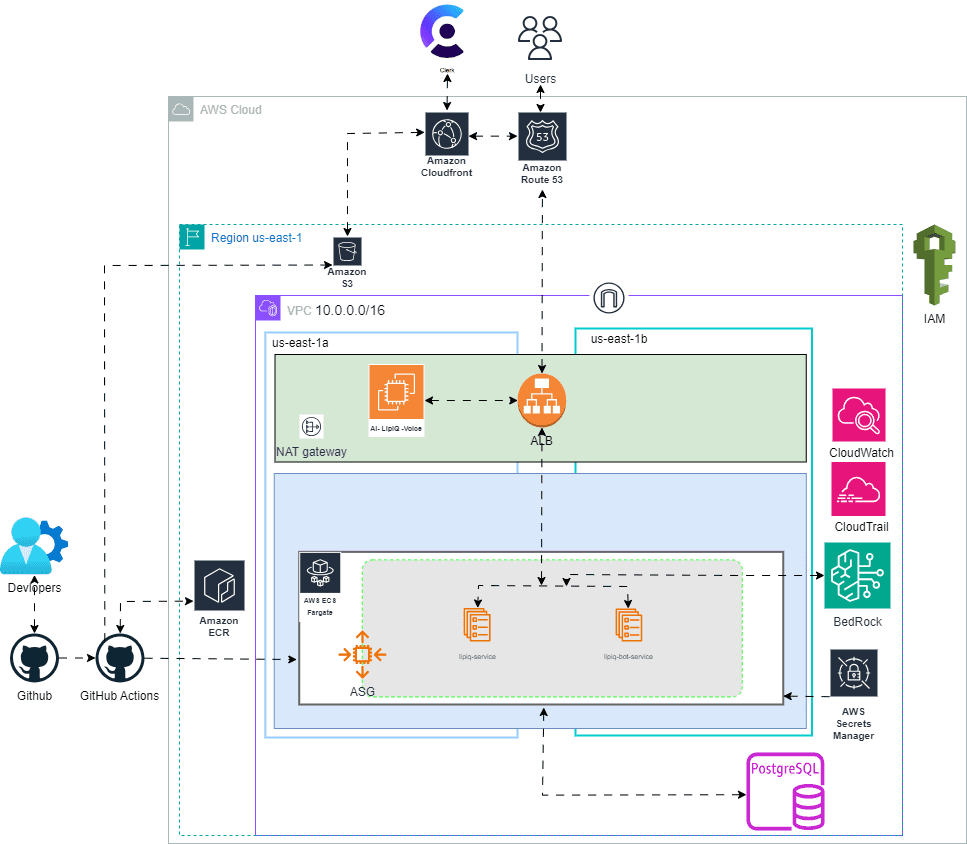
Implementation
Phase 1: Telephony Integration and Transcription Pipeline
LipiQ was integrated with the company's Zoom, Microsoft Teams, and Dialpad environments via API connectors that capture call audio streams in real time. The transcription pipeline uses a multi-model architecture: a primary ASR (Automatic Speech Recognition) engine optimized for conversational English with a domain-adapted vocabulary for SaaS sales terminology, and a secondary verification model that cross-checks low-confidence segments. Speaker diarization runs in parallel, using voice embeddings to attribute each utterance to the correct participant. For recurring contacts, LipiQ builds a voice profile over successive calls, improving diarization accuracy from 91% on first contact to 97% for known speakers. The full pipeline—ingestion, transcription, diarization, and initial structuring—completes within 90 seconds of call end.
Phase 2: Conversation Intelligence Extraction
With accurate speaker-attributed transcripts in place, a post-call analysis layer extracts structured intelligence from each conversation. An entity extraction model identifies competitor mentions, product feature references, pricing discussions, and timeline commitments. A sentiment analysis model tracks emotional tone per speaker across the call timeline, flagging moments where client sentiment shifted notably—such as enthusiasm following a demo segment or concern during pricing discussion. A talk ratio analyzer computes the percentage of time each participant spoke, benchmarked against the company's top-performer baseline of 40% rep / 60% client. Action items and next steps mentioned in the call are extracted and formatted as structured tasks. All extracted intelligence is pushed to the CRM via a bidirectional sync, enriching the contact and opportunity records without requiring any manual input from the sales rep.
Phase 3: Analytics Dashboard and Coaching Integration
A conversation analytics dashboard was deployed for sales managers and revenue operations, providing aggregate views across all team calls. Managers can filter by rep, deal stage, time period, or outcome to surface patterns: which competitors are mentioned most in lost deals, which discovery questions correlate with higher win rates, which reps consistently exceed the target talk ratio. A coaching module highlights specific call segments for review—such as a rep's handling of a pricing objection or a top performer's discovery question sequence—and allows managers to bookmark, annotate, and share segments directly within the platform. Weekly automated digests summarize team-level trends: new competitor entrants, emerging objection themes, and shifts in client sentiment by segment.
Related Resources
View allThe Untapped Data Asset: Why Enterprise Voice Data Is Sitting Unused
Sales calls, client meetings, support calls, board discussions — enterprises generate thousands of hours of voice data weekly. Almost none of it is analyzed. That's a significant missed opportunity.
Speaker Diarization: The Technology Behind Who Said What
A transcript that reads 'Speaker 1: ... Speaker 2: ...' is less useful than one that reads 'Client: ... Account Manager: ...' Accurate speaker attribution transforms meeting records from notes to intelligence.
From Chatbots to Agentic AI: Why Orchestration is the New Standard
The shift from reactive chatbots to proactive agentic systems is not an upgrade—it's a fundamental architectural rethink. Here's why orchestration is the only path forward for enterprise AI.